
Round Rock, Texas · Slabs on clay or rock
Slab Foundation Repair in Round Rock, TX
Deep clay or shallow rock under the slab? The answer changes the repair.
A slab that has started to move usually shows it in small ways first: a crack creeping up from a door corner, a tile line that splits, a door that won't latch. Slab foundation repair in Round Rock, TX means finding why that part of the slab moved, then supporting it on something steadier than the soil that let it drop. What sits under your slab decides how that's done, and around Round Rock the answer can be thick clay or limestone less than a foot down.
- Free inspection
- No obligation
- Town-by-town soil data
- Referral service, disclosed
- Call (737) 259-7007
What have you noticed?
A free inspection is the place to start. A local foundation repair professional measures the floor and tells you what they find.
What Slab Foundation Repair Fixes
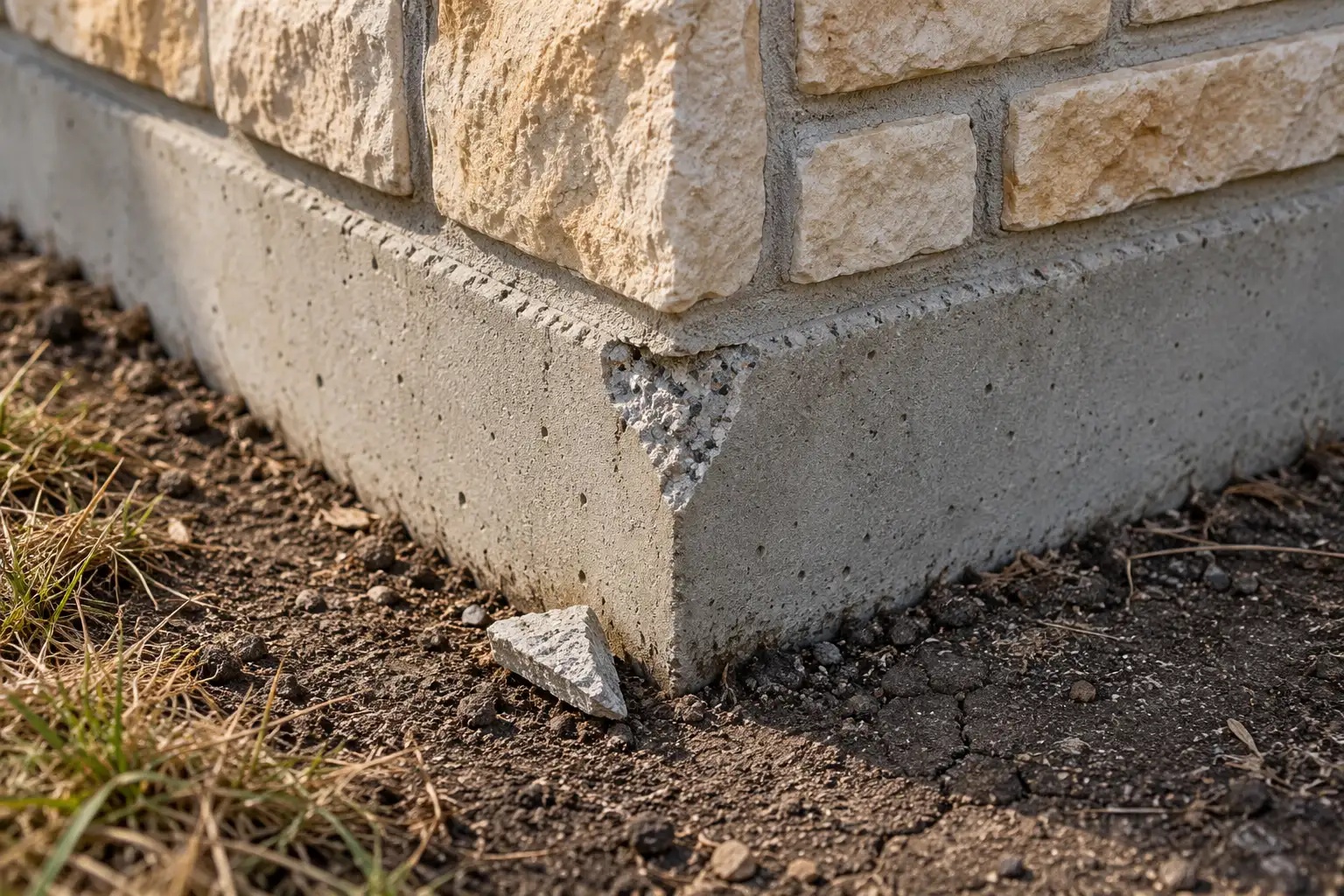
A slab is a concrete floor poured straight onto the ground. When the ground under one part of it shrinks, swells or washes out, that part moves and the rest of the house has to bend around it. The repair deals with that uneven support. It's the usual answer for:
- A corner or edge of the house that has dropped
- Cracks in drywall or stone that run from the corners of doors and windows
- Doors that stick or swing open on their own, in one part of the house
- Floor tiles cracking in a line across a room
- A gap opening between the slab edge and the brick or stone above it
Not every one of those signs needs piers. The guidelines Texas engineers use list cracked walls, racked door frames and split floor coverings as possible signs of movement, then add that seeing some of them doesn't by itself mean a foundation has failed. That's why a measured floor survey comes before any talk of repair.
West of I-35 or East: What Changes
Round Rock sits on a geological break, and the slab repair problem looks different on each side of it. We sampled the USDA soil survey at 25 points per town, and the towns sort by their soil, not by the highway.
In the clay towns, the ground itself is the problem. Houston Black clay, 16% of our Round Rock sample and 48% of Pflugerville's, reads 12.0 on the USDA's shrink-swell scale from the surface all the way down, with no rock in the top 80 inches. Branyon clay, the top soil in Hutto and Taylor, reads 9.9 in its first foot and 13.0 below that.
On soil like this, a slab rises when the clay is soaked and drops when it dries. The fix is to reach past that moving layer. A paper by Houston-area repair contractors and consultants describes the goal of a drilled pier as support "below the active zone of the soil."
In the limestone towns, there may be very little soil to move. Eckrant, the top soil in Cedar Park and Leander, has limestone 8 to 11 inches down in every Eckrant map unit we read there. Very high shrink-swell clay showed up at 0% of Cedar Park's points. A slab there that moves deserves a hard look at other causes too, especially water.
The exception is Georgetown soil, nearly half of Brushy Creek's sample. Its top 7 inches read just 2.5, but the layer beneath is 70% clay and reads 8.5, sitting on rock about 35 inches down. A stony yard can hide sticky clay.
On the break, you can have both on one street. Round Rock's own sample was 24% very high clay, 20% Austin silty clay over chalk and 16% Eckrant over limestone. Two neighbors can need quite different repairs, which is one more reason to measure before anyone quotes.
What the Work Involves
Most slab repairs follow the same broad steps, though each house gets its own plan.
1. A floor survey. The professional measures the height of the floor at points across the house to find the low areas and how far they've dropped. 2. An engineer's plan. In Round Rock and Georgetown, the city wants a plan stamped by an engineer before it issues the permit. Round Rock's fee is $125; Georgetown's is $50 plus a $10 technology fee. 3. Piers under the low areas. Holes are dug beside the outside beam, and under the slab where interior piers are needed. Pressed concrete or steel piles are pushed down with the weight of the house until they stop sinking, or until steel piles reach the needed resistance or rock. Each pier can end at a different depth. 4. Lifting and shimming. The low sections are raised back toward level and held there on the piers. 5. Checks afterward. The Texas engineering guidelines call for the floor to be measured again after the work, and for water and sewer lines to be tested for leaks when the house was lifted. In Round Rock, a final engineered report is needed before the city's final inspection.
How many piers? A precast pile guideline from the same Houston group sets the gap between outside piles at no more than 8 feet on a one-story wood or brick house. Every corner gets a pile too, and so does the middle of any room that measures 12 feet or more. On a 40-foot wall at 8 feet apart, that's six piles. It's an example, not a quote: an engineer can lay out a different plan.
Two honest limits are worth knowing before you sign. The Texas guidelines say piers don't improve the slab where no piers go. They also say lifting is unlikely to leave a foundation perfectly level, so expect a floor that's near level and holding steady.
If your slab is post-tensioned
Many newer Texas slabs have steel cables running through them, pulled tight after the concrete sets. A trade guide warns never to cut or drill into these slabs, because a cut cable is very hard to repair. Look for a stamp warning about the cables; one source says it's usually in the garage floor. If you find one, tell whoever comes out.
What It Costs
Published prices around Austin and Round Rock don't agree, so treat them as a range to ask about, not a price for your house.
- A Texas repair company's 2026 Austin cost guide lists $350 to $500 per pressed concrete piling, $400 to $650 for steel and $450 to $700 for a helical pier. It puts a typical concrete-pile job at 8 to 15 pilings.
- Another Texas company with a Round Rock office lists about $1,000 to $3,000 per pier.
The number of piers moves the total more than anything else, and only a floor survey shows how many you need. Then add the city's permit fee and the engineer's plan. One guide puts an engineering report at $500 to $1,500. Our cost guide lines up every published price we found.
Questions About Slab Foundation Repair
Can't they just pump grout under the slab instead?
That's mudjacking. One company with a Round Rock office puts a whole mudjacking job at $1,000 to $3,000, the same range it lists for a single pier. The Houston contractors' paper calls it a shallow repair: if the soil's moisture changes, the slab can move again. On deep clay that's worth weighing carefully.
Will piers stop my slab from rising when the clay gets wet?
Not on their own. The same paper says the piers most often used under Houston-area homes aren't tied to the slab, so they can't hold it down if wet clay heaves. Keeping the soil around the house evenly moist, and rainwater running away from it, helps the repair do its job.
Does a warranty cover my cracked drywall?
Usually not. The Houston precast pile guideline says a repair warranty typically leaves out finishes like drywall and brick, and doesn't cover upward movement unless the contract says so. Read that part of any contract closely.
Related Services
- Foundation inspection: the measured first look that tells you whether a slab needs repair at all
- House leveling: when the slope runs through the whole house, not one corner
- Foundation crack repair: sorting a cosmetic crack from one that points to movement
Towns We Serve
Slab repair is available across our area, on limestone and clay alike: Georgetown, Cedar Park, Leander, Brushy Creek, Liberty Hill, Wells Branch, Pflugerville, Hutto, Manor, Taylor and Elgin. See all service areas.
Get a Free Slab Inspection in Round Rock
Tell us what you've noticed and the town or ZIP code of the house. We'll pass it to a local foundation repair professional, who'll measure the floor and walk you through what they find. The visit is free.
What have you noticed?