
Round Rock, Texas · Cosmetic or structural
Foundation Crack Repair in Round Rock, TX
Most cracks are only skin deep. Here's how to tell the ones that aren't.
Finding a crack in a wall, a slab or the stone outside is unsettling, but it isn't a verdict on your house. The guidelines Texas engineers use say the majority of cracks don't compromise a structure's strength. Foundation crack repair in Round Rock, TX starts by reading the crack. Where is it, how wide, and is it growing? How old is the house? Then it's fixed in the way that reading calls for, which is sometimes just a patch.
- Free inspection
- No obligation
- Town-by-town soil data
- Referral service, disclosed
- Call (737) 259-7007
What have you noticed?
A free inspection is a quick way to get a crack read by a local foundation repair professional.
Cosmetic or Structural?
No single clue settles it. Still, a few help, and HUD's guide to inspecting older homes describes most of them.
- Where it starts. Cracking is most likely at corners and beside doors and windows. The Texas engineering guidelines also list racked door and window frames among the visible signs of movement.
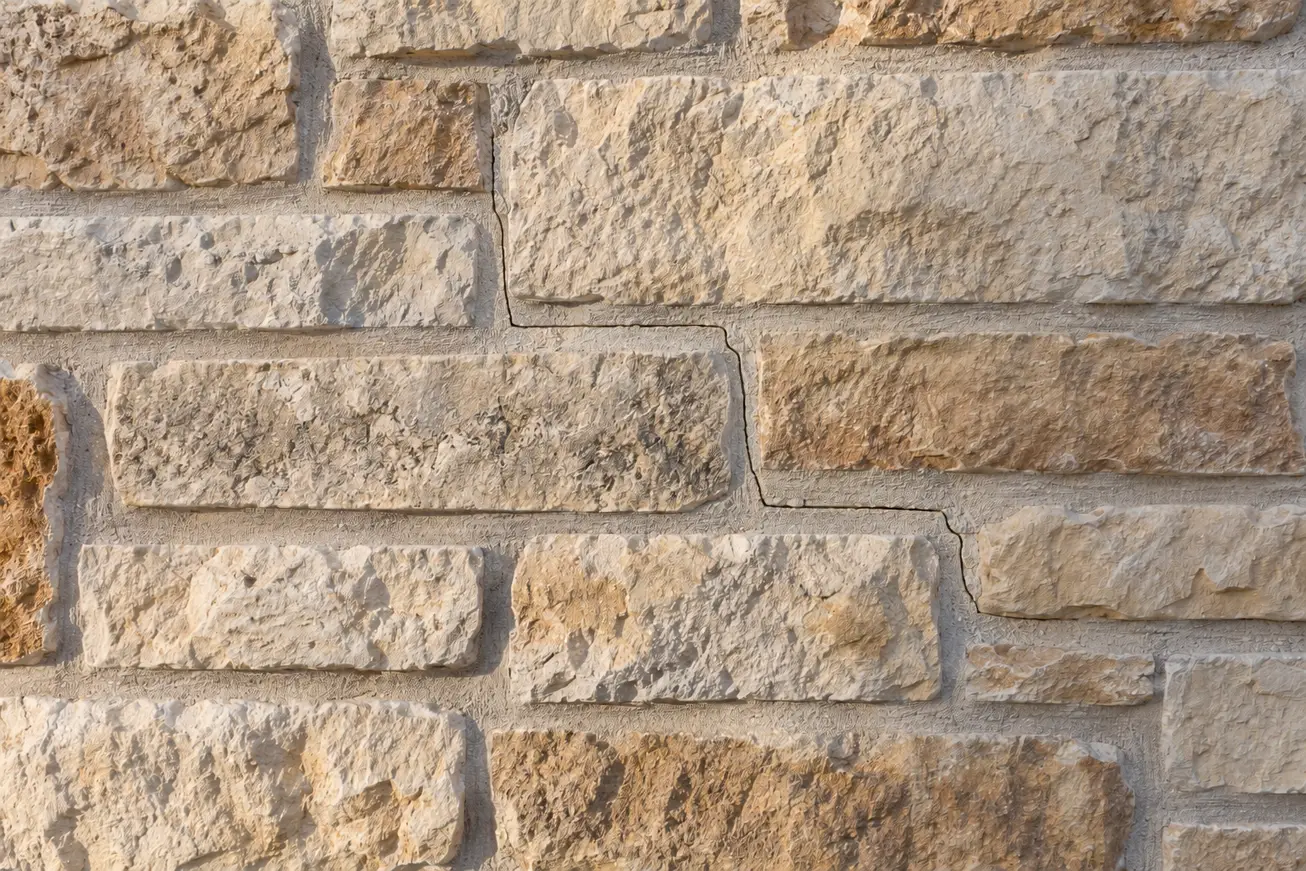
- Its path through masonry. In brick or stone, cracks usually follow a rough diagonal along the mortar joints.
- Its taper. Faster settlement, HUD's guide says, makes cracks that taper: wide at one end, a hairline at the other.
- Its edges. A clean crack points to recent movement. A dirty crack, or one that has been filled before, may no longer be moving.
- Its size. HUD's housing inspection standard flags a foundation crack at 1/4 inch wide and 12 inches long, or bigger.
The drawing on this page shows four common patterns. There's a hairline in a painted wall and a stair-step crack through brick mortar. There's also a diagonal from a window corner, and a crack across a concrete floor. The pattern alone doesn't tell you the cause or how serious it is. That takes a look at the whole house.
How old the house is changes the reading
HUD's guide adds a useful point. A half-inch crack in a new building may be a sign of fast settlement. If the building is 50 years old, a crack that wide could come from slow creep, as little as 1/100 inch a year.
That's a real difference across our area. Round Rock's median home was built in 2001, and in Hutto 95.3% of homes date from 1990 or later. In Taylor, half the homes were built in 1978 or earlier. So the same wide crack can mean something more urgent in a young Hutto house than in an old Taylor one.
Four kinds of crack
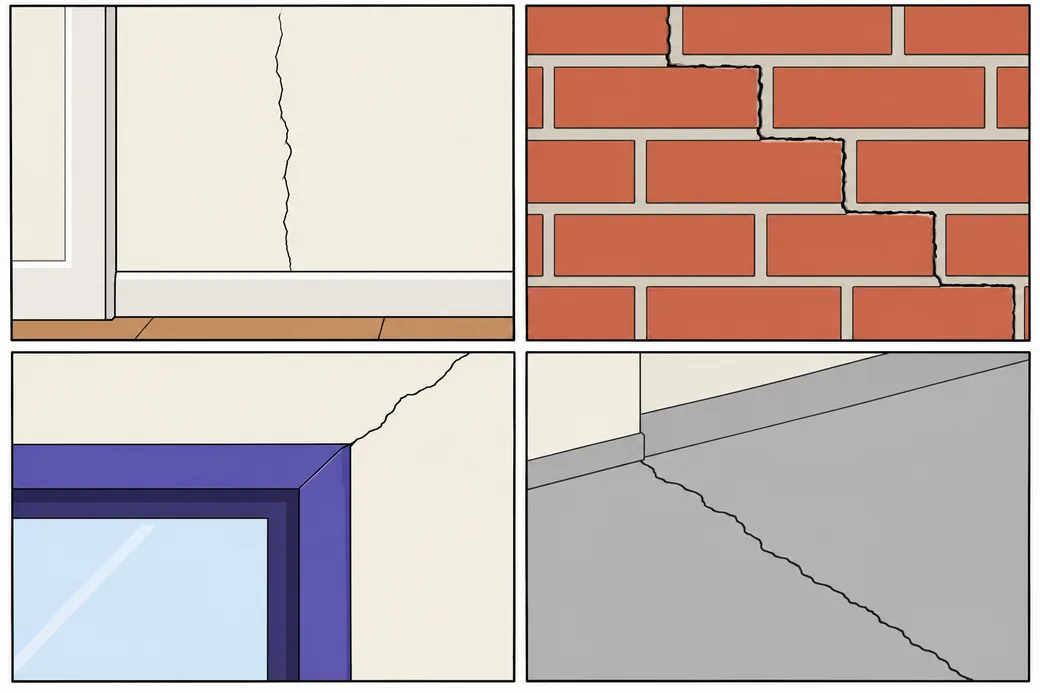
- A fine crack in a painted wall
- A crack stepping along brick mortar
- A crack rising from the corner of a window frame
- An uneven crack across a concrete floor
West of I-35 or East: What Changes
In the clay towns, cracks can open and close with the seasons. HUD's guide says seasonal movement makes some cracks regularly open and close. Branyon clay covers nearly half of Hutto's sample, and Houston Black 48% of Pflugerville's. On soil like that, a crack may widen through the dry summer and tighten after the rains. The weather station northeast of Round Rock averages just 2.04 inches of rain in July and 4.07 inches in October. Measuring a cycle like that can take six months or more, HUD says, so mark the crack and check it again each season.
In the limestone towns, look at other causes too. Across much of Cedar Park and Leander, Eckrant soil has limestone 8 to 11 inches down. That leaves little clay to swell.
HUD lists other usual causes of wall and ceiling cracks. Framing can sag and wood can warp. Building materials also shift a little with heat and humidity. Water collecting against the foundation is worth checking as well.
On the break, Round Rock can show both patterns. At one end of its sample sits Houston Black clay, with no rock in the top 80 inches. At the other is Eckrant, with rock about 11 inches down.
What the Work Involves
- Reading the crack. Its location, width, edges and taper are checked, along with the floor heights nearby.
- Watching it, if it's unclear. Mark each end with a pencil line and the date, or fit a crack monitor. Over time, you'll see whether it grows.
- Fixing the cause first. If the crack points to movement, deal with that before any patch. A patch can't hold a crack that's still moving.
- Then the crack. A cosmetic crack is patched or sealed to keep water out and make it look right.
Cracks in a post-tensioned slab
On a post-tensioned slab, the steel cable ends sit in grout-filled pockets along the slab edge. The Post-Tensioning Institute warns that moisture getting into a cable's sheathing can lead to rust. If one of those edge patches has cracked open or shows rust, point it out. Never drill into a post-tensioned slab to fix a crack until the cables have been located.
What Foundation Crack Repair Costs
One Texas company with a Round Rock office lists minor crack repairs at $500 to $1,500, the lowest line on its price list. If the crack turns out to be a symptom of movement, the cost depends on the repair it needs. Our cost guide covers those prices.
Questions About Foundation Crack Repair
Is it OK to caulk it before anyone sees it?
It's fine to wait until it's been read. A filled crack hides its edges, and HUD treats clean edges as a clue to recent movement. Mark the ends and the date, take a photo, then decide.
The crack in my brick goes up like stairs. Is that bad?
It's the classic pattern of masonry movement, following the mortar joints. It deserves a look, especially if it's wider at one end or keeps growing. On its own, though, it doesn't mean the foundation has failed.
Once it's patched, can it open up again?
It can, if the crack is still moving. Once any movement has been dealt with, a sealed crack has a far better chance of staying closed. Even then, HUD says some wall cracks open and close with the seasons.
Related Services
- Foundation inspection: a measured look that puts a crack in context
- Slab foundation repair: when a crack points to a slab that has dropped
- House leveling: when cracks show up in several rooms at once
Towns We Serve
We can help with foundation cracks across our area: Hutto, Taylor, Pflugerville, Manor, Elgin, Wells Branch, Georgetown, Cedar Park, Leander, Brushy Creek and Liberty Hill. See all service areas.
Get a Crack Looked At for Free
Send a few words about the crack and the town or ZIP code of the house. A local foundation repair professional gets your request and can come out to read it with you.
What have you noticed?